


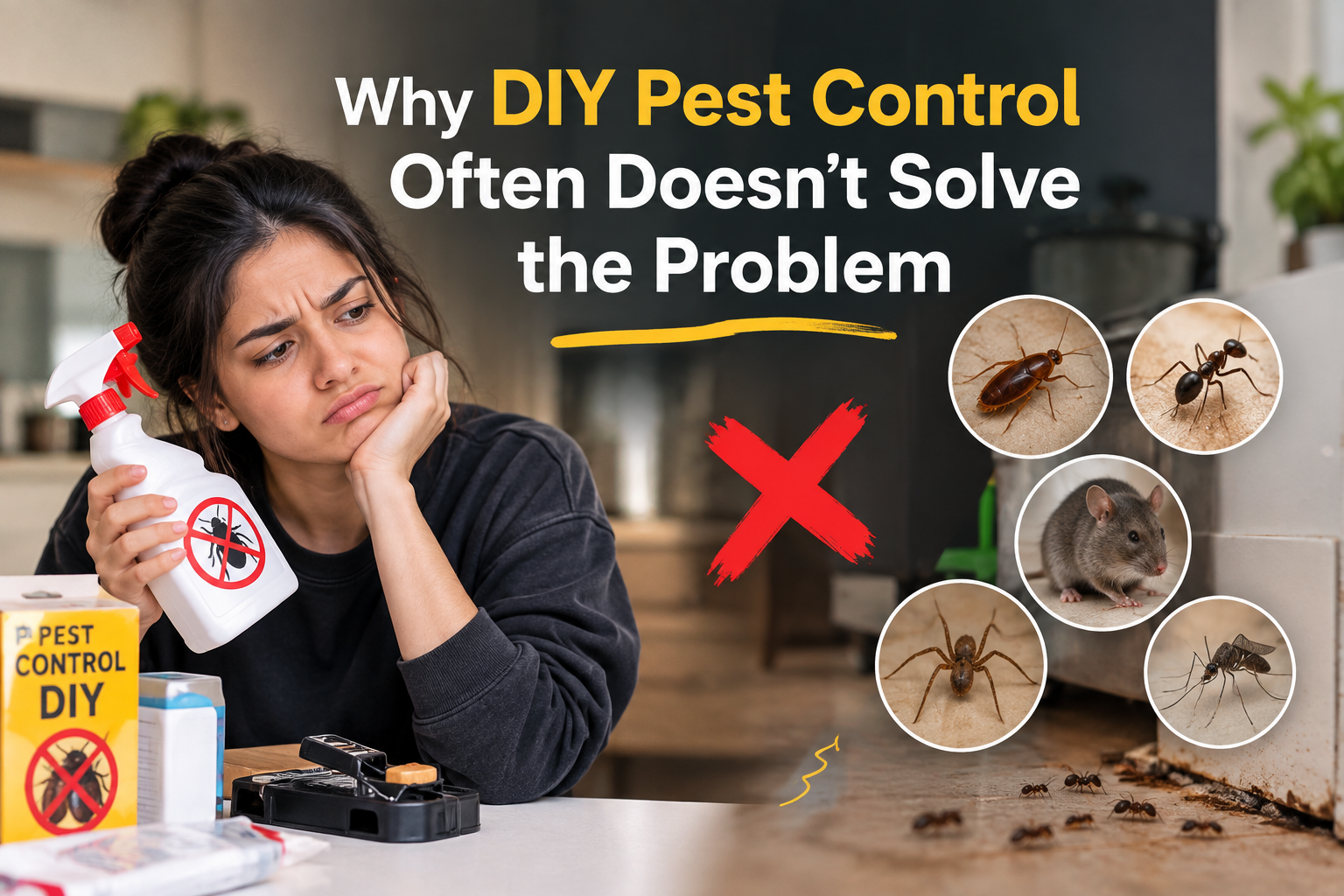

Why DIY Pest Control Often Doesn’t Solve the Problem
When you notice ants, cockroaches, mosquitoes, bed bugs, or other pests in your home, it can be tempting to buy a spray and handle the problem yourself.
DIY pest control products may help with some visible pests, but they do not always solve the underlying infestation. Pests can hide in areas you cannot easily reach, reproduce quickly, and return when the conditions that attracted them are still present.
Understanding why DIY pest control may fail can help you decide when professional pest control is more appropriate.
1. You May Only Be Killing Visible Pests
One of the biggest problems with DIY pest control is that you may only eliminate the insects you can see.
Many pests spend most of their time hiding behind:
- Kitchen cabinets
- Appliances
- Furniture
- Walls and cracks
- Drains
- Mattresses
- Storage areas
- Other dark, protected spaces
If the hiding or breeding areas are not addressed, more pests may appear later.
2. The Source of the Infestation May Be Missed
Seeing ants in your kitchen, for example, does not necessarily mean the problem is limited to the visible trail.
There may be a nest, entry point, food source, or moisture problem nearby.
Similarly, seeing cockroaches in a bathroom may indicate activity in nearby plumbing or wall spaces.
Finding and addressing the source is an important part of effective pest management.
3. Incorrect Identification Can Lead to the Wrong Treatment
Different pests require different control methods.
Ants, cockroaches, termites, bed bugs, mosquitoes, and rodents behave differently and respond differently to control measures.
If the pest is incorrectly identified, the treatment may be ineffective or unsuitable for the situation.
Professional pest control technicians can help identify the pest and determine the appropriate approach.
4. Some Pests Require Multiple Treatments
Certain infestations cannot always be eliminated with a single application.
Bed bugs are a good example. They can hide in many locations, and eggs may survive some treatments. Follow-up inspections or treatments may therefore be necessary.
Other infestations may also require monitoring and repeated treatment depending on their size and severity.
5. Pests Can Develop Resistance
Repeated use of the same type of insecticide may not provide effective control in every situation.
Some pest populations can show reduced sensitivity to certain insecticides. Using more of a product does not necessarily solve the problem and can create unnecessary exposure risks.
Always follow the product label and never use more than the recommended amount.
6. Entry Points May Remain Open
Spraying pests without addressing how they enter your property can result in recurring problems.
Common entry points include:
- Cracks in walls
- Gaps around doors
- Window openings
- Pipe penetrations
- Drains
- Roof or ventilation openings
Sealing appropriate entry points can be an important part of long-term pest prevention.
7. Food and Water Sources May Still Attract Pests
Pest control treatment alone may not be enough if the conditions attracting pests remain.
Food crumbs, uncovered garbage, standing water, leaking pipes, pet food, and moisture can continue to attract pests.
Good sanitation and moisture control should therefore be combined with pest treatment.
8. Some DIY Treatments Can Be Unsafe
Pesticides are chemicals and should be used carefully.
Using products incorrectly, mixing chemicals, applying them to unsuitable surfaces, or ignoring label instructions can create unnecessary risks for people, pets, and the environment.
Always read and follow the product label before using any pesticide.
9. Professional Pest Control Uses a More Comprehensive Approach
Professional pest management generally involves more than simply spraying visible insects.
Depending on the situation, a technician may:
- Inspect the property.
- Identify the pest.
- Locate potential hiding and breeding areas.
- Identify food, water, and entry points.
- Recommend appropriate treatment.
- Provide prevention and follow-up guidance.
This approach can help address the conditions contributing to the infestation.
When Should You Call a Pest Control Professional?
DIY methods may be reasonable for minor pest activity, but professional help may be appropriate when:
- Pests keep returning.
- The infestation is increasing.
- You find nests, eggs, or droppings.
- Multiple rooms are affected.
- There is property damage.
- You cannot identify the pest.
- DIY treatment has not worked.
- You are dealing with termites, bed bugs, or a significant rodent infestation.
How to Make Pest Control More Effective
Whether you use DIY methods or professional services, prevention plays an important role.
Try to:
- Keep food stored in sealed containers.
- Clean spills and crumbs quickly.
- Empty garbage regularly.
- Fix leaking pipes and taps.
- Remove standing water.
- Reduce clutter.
- Seal suitable cracks and gaps.
- Inspect second-hand furniture and belongings.
- Keep kitchens and storage areas clean and organized.
Conclusion
DIY pest control can sometimes help with minor pest activity, but it may not eliminate an established infestation. Killing visible pests without addressing their hiding places, food sources, moisture, breeding areas, or entry points can allow the problem to return.
If pests continue to appear despite your efforts, a professional inspection can help identify the cause and determine the appropriate treatment.
Effective pest control is not just about eliminating the pests you can see—it is about addressing the conditions that allow them to survive and return.